Lead pipeline and client management
The README lists lead capture, qualification scoring, stages and lead-to-client conversion, together with client preferences, budget tracking, interaction history and appointments.
Explore a full-stack real estate CRM project with React, TypeScript, Express, PostgreSQL, leads, properties, calendars, dashboards and automation.
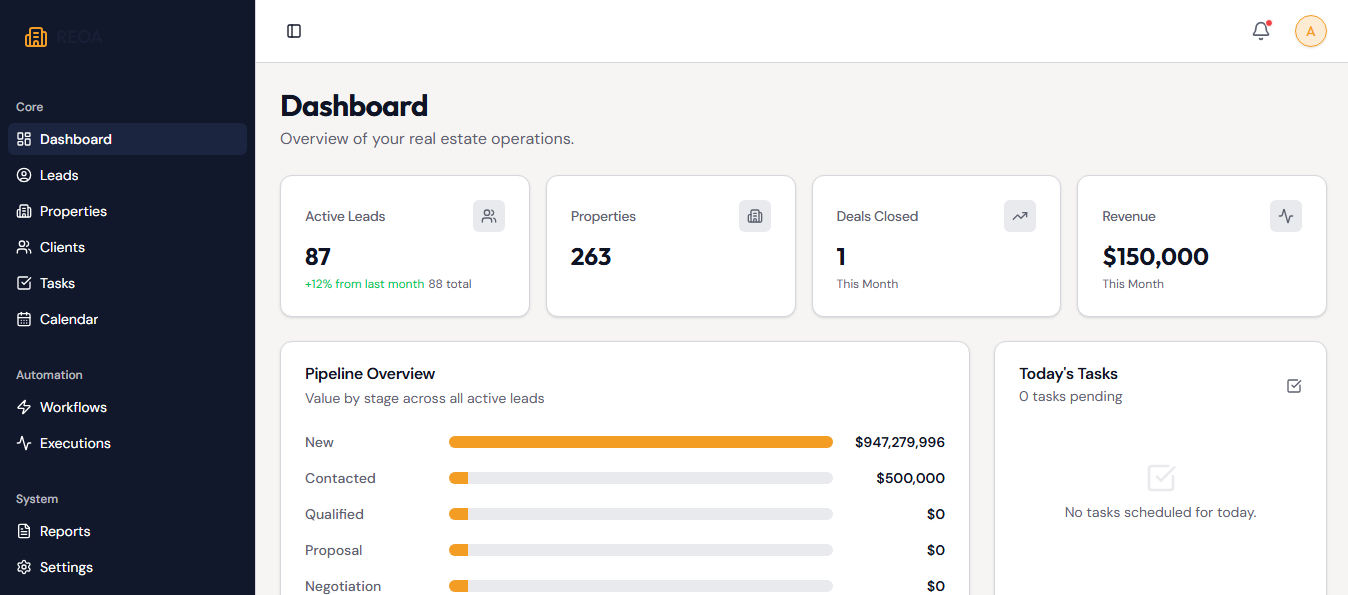
Project image from the Kumail Raza portfolio.
Real Estate Operations is a portfolio project bringing several parts of property business administration into one application. The documented product areas include lead management, CRM, property inventory, viewing appointments, task tracking, reporting and workflow automation.
The project's public GitHub README describes a React and TypeScript frontend, a Node.js/Express API, PostgreSQL or Supabase persistence, and a multi-package architecture. This page focuses on that recorded implementation scope, not on an assumed production rollout or business ROI.
Real estate teams commonly manage leads, customer preferences, listings, appointments and follow-up tasks as related workflows. A joined-up product needs to maintain those relationships rather than treat each screen as a disconnected spreadsheet.
The project's application model connects lead progression to clients, available properties, scheduled viewings and the work that follows an event. The result is a workflow-oriented CRM rather than only a property gallery.
The README lists lead capture, qualification scoring, stages and lead-to-client conversion, together with client preferences, budget tracking, interaction history and appointments.
Property inventory includes status and listing information; the appointments area handles scheduled, completed and cancelled viewings via a calendar.
The project documents task priority and deadlines, a notifications center and links back to the records that triggered an alert.
The README describes reactive events such as lead creation, viewing completion and property sales, plus a periodic scheduler for reminders and overdue task checks.
Documented reporting includes pipeline activity, stage distribution, conversion-oriented KPIs and team activity views.
React, TypeScript, Tailwind and a structured Express API separate the interactive CRM interface from backend operations.
PostgreSQL/Supabase and Drizzle ORM are listed for application data and relational workflows.
The project's README includes Zod validation and reusable packages for database, API schemas and client interfaces.
The README notes batching, deduplication and idempotent execution history—useful concerns where repeated background events could otherwise trigger duplicate work.
This case study shows the breadth of implemented and documented modules in a full-stack CRM architecture. No independently verified client savings, business adoption figures or uptime metrics were supplied, so such results are not claimed.
For broader capabilities, visit full-stack development services.
I'm based in Pakistan and collaborate remotely with clients and agencies internationally. Share your brief, current technology and goals.